Truck Accident Evidence Preservation in California
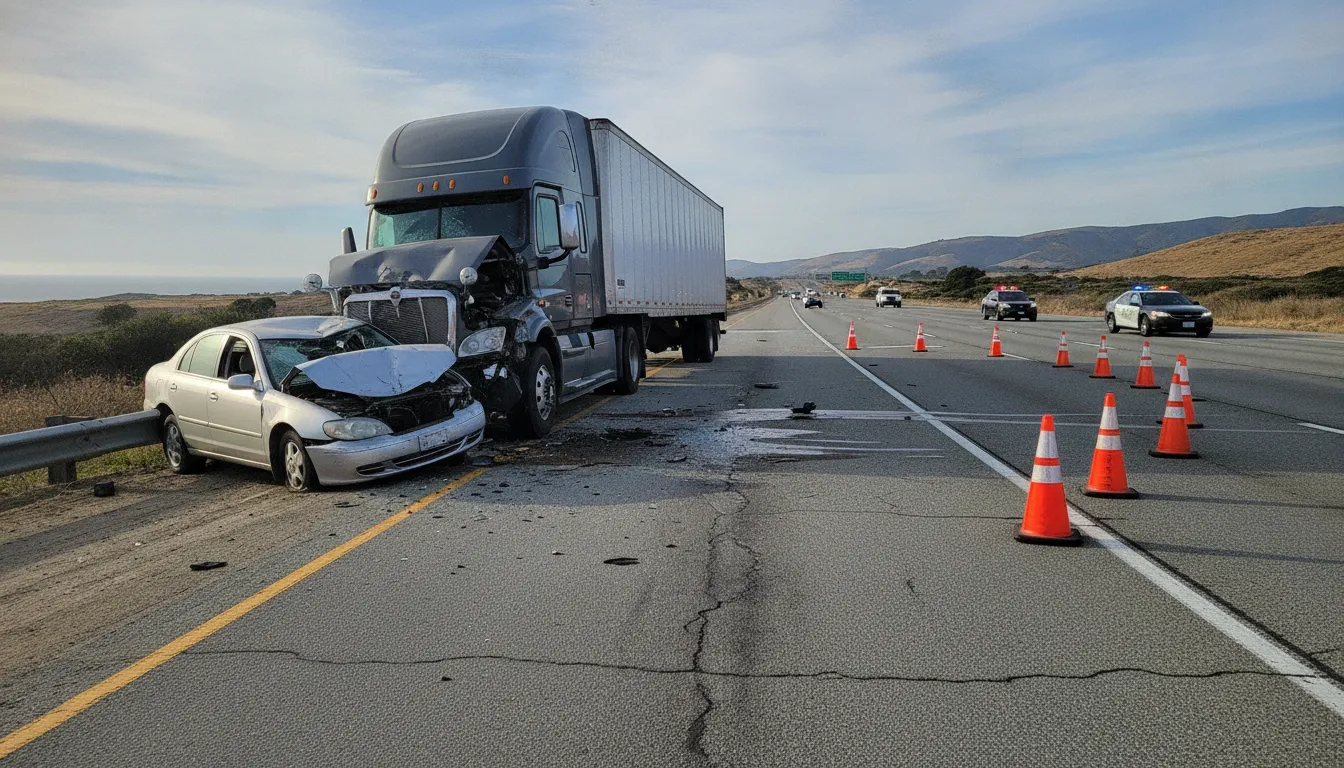
Truck accident evidence preservation starts in the first hours, not at a deposition months later. A commercial rig can hold speed, brake, and hours data that a passenger car never records. The carrier keeps most of it. Federal rules tell that carrier how long to store driver logs, and the clock is short. If nobody asks in writing, useful files can be overwritten, returned with the truck, or boxed up and forgotten.
This guide is for someone hurt in a California crash with a semi, box truck, or other commercial vehicle. It explains which records matter, who holds them, and what a plain preservation request should name. It is general information, not legal advice for your crash.
Call 800-200-HURT for a free consultation about preserving truck crash evidence.
Why Truck Accident Evidence Preservation Cannot Wait
A car crash file is often the police report, photos, and two insurance policies. A truck crash file is larger because the vehicle is a business. The driver, the motor carrier, a shipper, and a maintenance shop can each hold a piece. Some pieces live on a device that records over itself. Others sit in a file the company must keep only for a set number of months.
Waiting for the insurance adjuster to “send everything” is a weak plan. The adjuster works for the insurer. You can still be polite. You should also make your own list and send a written hold before the short clocks run. A commercial truck accident law firm can send that hold and follow it with formal demands. You do not need to pick a firm before you photograph the scene and get medical care.
Speed matters for a second reason. Trucks move. A tractor can be repaired, sold, or sent back out on a route. A trailer can be dropped at a yard in another county. Once parts are replaced, the broken brake, tire, or coupling is gone unless someone tagged it. Photos of the damage help, but the part itself is better.
What Truck Accident Evidence Preservation Should Cover
Think in two piles. One pile is what you can save yourself. The other is what the carrier, a vendor, or a public agency holds. Truck accident evidence preservation has to reach both piles. A perfect letter that forgets your own photos still leaves holes. A full camera roll that never asks for the driver’s logs leaves the bigger hole.
| Record | Who usually holds it | Why it matters |
|---|---|---|
| Scene photos and video. | You, passengers, or nearby drivers. | Shows lane, damage, debris, and weather before the scene is cleared. |
| Police or CHP report. | The investigating agency. | Names the driver, the carrier, and the first account of the crash. |
| Event data recorder file. | The vehicle maker or a download technician. | Can show speed, throttle, and brake use just before impact. |
| Engine control module data. | The carrier or the truck maker. | May show hard braking, fault codes, and recent speed. |
| ELD or paper logs. | The motor carrier. | Shows hours on duty and whether the driver was out of time. |
| Accident register and reports. | The motor carrier. | Lists the crash, injuries, and reports sent to the state or insurer. |
| Maintenance and inspection files. | The carrier or a repair shop. | Shows whether brakes, tires, or lights were overdue. |
| Dispatch messages and bills of lading. | The carrier, a broker, or the shipper. | Shows the route, the load, and who controlled the trip. |
You will not get every row on day one. The point of the list is to name the rows early, so a later “we no longer have that” is harder to explain. Keep a copy of every request you send.
Black Box and Engine Data to Preserve
People say “black box” for two different devices. One is the event data recorder, or EDR, common in newer passenger vehicles and some commercial trucks. Federal rules in 49 CFR 563.7 list elements an equipped vehicle must record, including indicated speed, throttle or accelerator position, and whether the service brake was on. Those elements cover the seconds just before impact. They are not a full trip history.
The other device is the engine control module on a heavy truck. It can store a sudden-deceleration event, fault codes, and a short speed history. It is not the same chip as a car EDR, and it is not covered by the same rule. A technician with the right software downloads it. Driving the truck, clearing codes, or swapping the module can wipe the useful slice.
Ask, in writing, that the carrier and any leasing company do all of the following:
- Park the tractor and trailer, or separate the damaged unit from the fleet.
- Do not clear fault codes, reset the module, or install a replacement module.
- Do not repair or sell the unit until a download is done.
- Keep the original download file, not only a printed summary.
Your own car may have an EDR too. If your car is totaled and headed to a salvage yard, say you want that module imaged before the car is crushed. Airbag control units are often the place the file lives. A shop that “just fixes the car” can overwrite it.
Driver Logs and the Six-Month Clock
Hours rules exist so a tired driver is not legal to drive. The proof is the record of duty status. Many carriers use an electronic logging device. Some still use paper in narrow cases. Either way, the file shows on-duty time, driving time, and breaks.
FMCSA guidance on ELD retention says a motor carrier must keep drivers’ records of duty status and supporting documents for six months under 49 CFR 395.8(k). The same guidance says a back-up copy of the ELD records must sit on a separate device for six months under 49 CFR 395.22(i). Six months from the crash is not a long time if you are still in treatment and have not hired anyone.
Supporting documents are the paper around the log. Think fuel receipts, bills of lading, dispatch records, and toll or scale tickets that show where the truck was. A log that says the driver was off duty in Fresno is weaker if a fuel receipt puts the truck in Santa Maria that hour. Ask for the log and the supporting set, not the log alone.
Name the driver, the date, the truck unit number if you have it, and the carrier’s USDOT number if it is on the door. Ask the carrier to hold the file even if six months pass while a claim is open. A private hold letter does not rewrite the federal retention rule. It does tell the company you want the copies kept for the claim.
The Accident Register and Company Reports
Separate from the driver log, motor carriers keep an accident register. 49 CFR 390.15 says that register must be kept for three years after the date of each accident. Each entry needs the date and the city or town, plus the state. It also needs the driver name, the injury count, and the fatality count. It must say whether hazmat was released, other than fuel from the truck’s own tanks.
The same rule requires copies of accident reports the state or an insurer required. That is a different stack from the public CHP report you can order yourself. Get both. The public report is the first narrative. The carrier’s copy can show what the company told its insurer.
Three years sounds comfortable next to the six-month log rule. Do not treat it as a reason to wait. Reports get summarized. Photos attached to an internal file get dropped. A short letter now is easier than a fight later over a missing attachment.
Maintenance, Cargo, and Dispatch Files
Logs show the driver. Maintenance files show the truck. Driver vehicle inspection reports, annual inspection records, brake-work orders, and tire invoices can show a problem the company knew about. A shop that is not the carrier may hold the invoice. Name that shop in the hold if you saw its name on a sticker or the police report.
Cargo files answer a different question: who loaded the trailer, and was the load legal. A bill of lading, a weight ticket, and photos of shifted freight can matter when the crash involved a wide turn, a rollover, or debris. The shipper or a warehouse may hold those papers, not only the carrier.
Dispatch texts, Qualcomm-style messages, and broker emails show the delivery window. A message that says “receiver closes at 4, do not miss it” is different from a normal route plan. Ask for messages for the day of the crash and the day before. That window is where fatigue pressure usually shows up.
Do not promise a specific cause in the letter. “Preserve maintenance and dispatch records for unit 441 on March 2” is enough. Arguing the cause before you have the file can wait.
What You Can Save Before a Lawyer Is Involved
You do not need a court order to save the evidence in your own hands. Do these steps while you are able, or ask a family member to do them.
- Get medical care and follow the discharge instructions. Your records are evidence of injury.
- Photograph the vehicles, the lanes, skid marks, debris, and the truck’s door, including the company name and USDOT number.
- Photograph the trailer, the load if it is visible, and any broken part before the tow truck leaves.
- Save the tow and storage invoices. Write down the yard address and the stock number.
- Ask the investigating agency how to order the report. Save the report number.
- Keep clothing, the car seat if it is damaged, and any cargo that struck you. Do not wash away fluid or paint transfer if you can safely bag the item.
- Write a short timeline the same day: where you were, the weather, and what you saw. Stick to what you know.
- Do not give a recorded statement to the trucking insurer before you understand the claim.
The scene steps in what to do after a semi-truck accident cover safety and first contacts. This list is the evidence slice of that work. If you already left the scene, save whatever photos you took and write down what you remember. Late notes are still useful if you date them.
Store copies in two places. A phone that dies, or a single email account you lose, should not be the only copy of the USDOT photo.
How to Send a Preservation Request
A preservation request is a letter or email that tells the holder not to delete specific records. It is not a lawsuit. In California, a later demand for inspection has its own rules, including a formal notice under the Discovery Act. You can still send a plain hold on day one. Courts can consider whether a party destroyed evidence it knew was relevant. The letter is how you show they knew.
Send it to the motor carrier, and copy the insurer if you have the claim number. Use the address on the police report and any address on the truck’s door. If a leasing company or a freight broker is named, copy them too. Email plus certified mail is a practical pair. Keep the tracking page.
A tight letter includes these points:
- The date, time, and place of the crash, and the report number if you have it.
- The driver name, plate, and truck or trailer unit numbers.
- A list of the files you want kept. Name engine data, driver logs, the accident register, maintenance files, dispatch messages, and dash-camera video.
- A request not to repair, sell, or return the unit to service before those downloads.
- A request to stop routine deletion for the accounts and devices that hold those files.
- Your name, a phone number, and a statement that you are hurt and may bring a claim.
You do not need legal jargon. You do need the truck identified well enough that a safety director can find the file. If you only know the company name and the date, say that, and attach your photo of the door.
Dash cameras deserve their own line. Many fleets overwrite video in days, not months. If you saw a camera on the windshield or the trailer, ask for that video. Cover the hour before the crash and the hour after it. Use the same line for a nearby lot camera that faced the road.
California Timing That Affects the File
Evidence clocks and lawsuit clocks are different. The six-month log rule and the three-year accident register are federal record rules for the carrier. Your deadline to file a lawsuit is a separate California limit, and the facts of the crash can change how it runs. Do not use this article as your filing calendar.
What you should not wait on is the short federal hold. If the crash was four months ago and nobody has asked for the ELD file, send the letter now. If it was eight months ago, still ask. The back-up copy may exist, or the carrier may have kept the file for its own insurer. Silence is how files disappear without a decision.
Medical records have their own path. Ask each hospital and clinic for a copy of your chart, the imaging, and the bills. Those records prove the injury side of the claim. They do not replace the truck’s data. Both sides of the file need a home.
If a city or county vehicle was involved, or the crash was on a public work zone, other notice rules can be short. That is a reason to talk with a lawyer early, not a reason to skip the carrier letter.
Where a Local Truck Crash File Usually Lives
On the Central Coast, a serious truck crash is often investigated by the California Highway Patrol. The report, the photos the officer took, and any witness cards sit with that agency until you order them.
The truck itself may be in a local tow yard in San Luis Obispo, Santa Maria, or a yard farther up the 101. Call the yard. Ask them not to release the vehicle to a scrapper until you have photos and, if needed, a download plan.
James McKiernan Lawyers was founded in 1983 and has spent over 40 years on Central Coast injury cases. The team has recovered more than $350 million for clients and has more than 500 five-star reviews. Local yards, CHP areas, and carrier terminals are familiar ground. That does not change the federal retention clocks. It does change how fast a hold can reach the right desk.
If your crash was in San Luis Obispo County, the firm’s San Luis Obispo truck accident lawyers page explains the local claim path. For the broader injury practice, start at the personal injury overview. Causes of these crashes, which tell you which file to ask for first, are covered in top causes of truck crashes.
Call 800-200-HURT before driver logs and camera video are overwritten.
Frequently Asked Questions
How fast should I start truck accident evidence preservation?
Start the day of the crash if you can. Photos, the tow yard name, and a written hold to the carrier are the pieces that spoil first. Driver logs have a six-month federal retention period. Camera video can be gone in days.
Can I download the truck black box myself?
No. The carrier, the truck maker, or a trained technician controls the download. You can demand that they preserve the module and not clear it. A lawyer can then use formal discovery to get the file.
What if the carrier says the logs were already deleted?
Ask when the deletion happened and whether a back-up still exists. FMCSA guidance requires a separate back-up of ELD records for six months. Write down the name of the person who told you the file is gone.
Does a preservation letter file my lawsuit?
No. It is a request to keep records. Filing a case, and the deadline for that filing, is a separate step. The letter helps if someone later destroys a file you asked them to keep.
What if I only have the company name?
Send the letter anyway. Include the date, the highway or cross street, and any photo of the truck. Ask the carrier to identify the driver and the unit. Order the police report so you can tighten the request later.
Talk With a Lawyer About the Hold
You can save your own photos today and still have a lawyer send the formal hold. Bring the report number, the tow invoice, and any picture of the truck door. The firm can tell you which files are still inside the retention window and which ones need a demand now.
Call 800-200-HURT to schedule a free consultation.
This article is general information about truck crash records in California. It is not legal advice, and it does not create an attorney-client relationship. Deadlines depend on the facts of your crash.