Parking Lot Car Accident Liability California
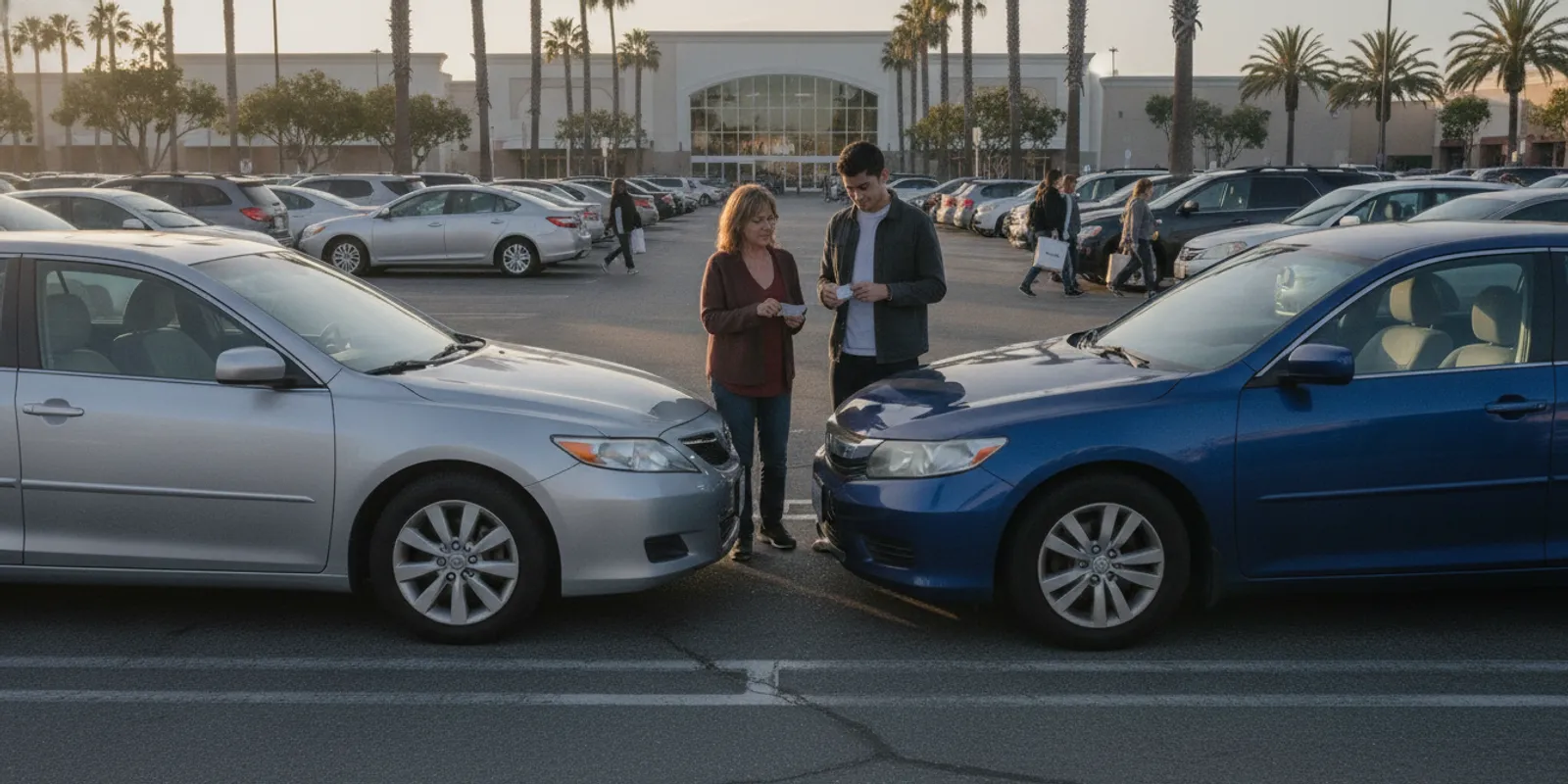
A parking lot collision can happen while one car backs out, another cuts through an aisle, or two drivers reach an intersection at once. Understanding parking lot car accident liability California drivers may face starts with a basic question: whose conduct contributed to the collision? The answer depends on the facts, not simply on who was moving or who had the larger vehicle.
Discuss your accident with our team
Parking lots create close quarters and limited sightlines. Painted arrows, stop signs, parked cars, pedestrians, and reversing vehicles can all affect what a careful driver should do. This guide explains how fault is commonly evaluated, what evidence can help, and when a property condition may raise a separate question.
How does California law evaluate parking lot car accident liability?
California follows comparative fault principles. More than one person may contribute to a crash, and responsibility may be divided according to the evidence. A driver is not automatically free from responsibility because the other vehicle was backing up. Nor is a driver automatically at fault merely because their car was moving.
The central issue is whether each person acted with reasonable care under the circumstances. Relevant details can include speed, direction of travel, visibility, attention, signals, the layout of the lot, and whether a driver had time to react. A person entering an aisle from a parking space may have different duties from a driver already traveling through that aisle. The exact facts still matter.
Lots open to public use may also have posted signs and traffic controls. Drivers should follow them and watch for people walking between cars. A painted line or customary driving pattern can help explain the scene. It does not, by itself, settle legal responsibility.
Which movements commonly cause parking lot disputes?
Backing out of a parking space
A driver reversing from a stall has a restricted view and should check carefully before moving. The driver should look for vehicles, pedestrians, and other hazards. They should stop if the path is not clear. A driver traveling in the aisle also needs to remain alert and respond reasonably to visible hazards.
Imagine a reversing car and an aisle-traveling car collide near the end of a row. Evidence may show whether the reversing vehicle entered abruptly, whether the other driver was traveling too fast for the crowded area, and whether either person could have avoided impact. Damage location can help reconstruct the sequence, but it rarely tells the whole story alone.
Two vehicles meet at an aisle intersection
Parking-lot intersections may have stop signs, painted markings, or no clear controls. Drivers should approach slowly and yield when required by a sign or other applicable rule. If both drivers say they arrived first, camera footage, witness accounts, and impact locations may help establish the sequence.
Consider an intersection with tall vehicles parked close to the corners. One driver may say the other entered without stopping. The other may explain that the view was blocked and that they moved forward slowly to see cross traffic. Photos taken from each driver’s approach can show whether the obstruction affected visibility. Video may clarify the timing.
Cutting across spaces or traveling against the flow
Some drivers take a shortcut through empty stalls or travel against arrows to reach an exit. That movement can create a conflict with a vehicle pulling into a space or moving in the expected direction. Investigators may examine markings, signs, sightlines, and each driver’s actions rather than assuming that a customary pattern answers every question.
Backing into a stopped vehicle
If a vehicle is lawfully stopped and visible, a reversing driver may have difficulty explaining why contact occurred. Still, location and timing matter. A vehicle that moved into the path moments before impact may present a different account from one that had been stationary for some time. A witness or camera angle can help establish whether the car was already stopped.
Two vehicles back out at once
When adjacent drivers reverse simultaneously, each may have a limited view and little room to maneuver. The timing of each movement, the angle of the stalls, and whether either driver paused to check can matter. A photo of the row after the cars are moved may not show where each vehicle began. If safe, record the stall numbers and take wide photos before the vehicles leave.
What evidence helps explain a parking lot crash?
Evidence can disappear quickly. Vehicles move, temporary hazards are cleared, and nearby businesses may overwrite camera footage. If you are able, take these steps without putting anyone in danger:
- Photograph each vehicle from several angles, including close views of damage and wide views of the lot.
- Capture stall lines, arrows, signs, stop controls, lighting, obstructions, and the approximate point of impact.
- Write down the time, weather, visibility, and the direction each vehicle was traveling.
- Ask witnesses for names and contact information, and note what each person observed.
- Record the store, lot, or property manager’s name. Ask promptly whether video exists and how long it is retained.
- Keep repair estimates, medical records, receipts, and insurer messages together.
Do not rely on memory alone for a complicated sequence. Make a simple sketch showing vehicle positions before and after impact. Label it as your recollection. Use arrows for direction of travel and mark any point where a driver stopped. Leave uncertain details out rather than filling gaps with guesses.
Photos should show both context and detail. A close-up can capture a dent, but a wider image may show the lane, parking stall, and nearby sign. Take pictures from the direction each driver approached. If a parked van blocked the view, document its position and height without moving it. Note whether the lot was crowded or whether pedestrian traffic affected either driver’s path.
For a broader checklist of records and next steps, see the firm’s auto accident information. If injuries are involved, the personal injury overview explains the firm’s general area of representation.
How can you request camera footage?
Ask the property manager or business promptly whether cameras cover the relevant aisle, entrance, or storefront. Describe the date, approximate time, and location. Ask that footage from a reasonable period around the collision be preserved. The business may have limits on what it can provide directly, but making a clear request can help alert the right person before routine deletion.
Keep a note of whom you contacted, when you asked, and what they said about retention. Do not assume a camera points at the impact location just because one is visible nearby. A camera may capture the approach or aftermath instead. Those views can still help establish vehicle movement or timing.
Can a parking lot owner share responsibility?
Sometimes the issue is not only how the drivers behaved. A property condition may contribute to a collision or injury. Examples might include a severely obscured stop sign, a lighting failure, a hazardous pothole, or a design feature that blocks an important sightline. Whether a property owner or manager may be responsible depends on evidence about the condition, notice, control, and its connection to the harm.
A driver’s mistake does not automatically establish property-owner responsibility. Likewise, a defect on the property does not prove that it caused the crash. Photos, maintenance records, incident reports, and testimony about how long a condition existed may be relevant. A legal review can help distinguish a driver-negligence issue from a premises-condition issue.
Document a suspected hazard before it is repaired, if safe and practical. Photograph it from the perspective of each approach. Note whether a sign or light was present but blocked. Avoid trespassing or altering the area to obtain evidence. If the concern is a pothole or faded marking, include a nearby fixed reference so the location can be found later.
Separate the hazard question from the driver question. For example, a blocked sign may explain why a driver did not see a stop control. It does not alone establish that the sign caused the collision. The evidence should connect the condition to a driver’s opportunity to see, react, or avoid the impact. Maintenance requests, inspection records, and repair dates may help establish how long the condition existed.
How do insurance and fault questions fit together?
Notify your insurer promptly and provide a factual account. Stick to what you observed. If you did not see the moment of impact, say so rather than guessing. Take care before accepting a fault conclusion based only on an early phone call or a brief inspection.
California requires drivers to demonstrate financial responsibility. For a policy or bond issued or renewed on or after January 1, 2025, Vehicle Code section 16056 sets higher minimum limits.
Those limits are $30,000 for injury or death of one person. They are $60,000 for injury or death of two or more people in one accident. Property damage coverage must be at least $15,000. The California DMV insurance requirements page states the same figures.
Older policies can still show the prior $15,000, $30,000, and $5,000 minimums until renewal. These minimums do not decide fault. They also may not cover the losses in a serious collision.
Coverage can depend on the policies involved, who owns each vehicle, and the type of loss. Property damage and bodily injury may be handled separately. If a driver has collision coverage, their own insurer may address vehicle repairs subject to policy terms and a deductible, then consider recovery from another responsible party. Do not assume that a claim decision on vehicle damage also resolves an injury claim.
Keep a clear record of each insurer contact. Note the date, the representative’s name, what documents were requested, and any deadline they mention. Save copies of estimates, photographs, medical bills, and written statements. If the insurer asks a question you cannot answer, explain that you do not know rather than estimating speed, distance, or timing without a basis.
For example, one insurer may focus on the point of impact and conclude that a reversing car entered the aisle. The other may point to the aisle driver’s speed or lack of attention. Those positions are evaluations, not substitutes for a complete factual record. Ask what evidence supports a conclusion and whether the adjuster has reviewed witness statements or available video.
What should you do after a parking lot collision?
- Check for injuries and immediate danger. Call emergency services when needed. Move vehicles only when it is safe and appropriate.
- Exchange information. Obtain names, contact details, registration, and insurance information. Keep the exchange calm and factual.
- Report the incident as appropriate. Follow applicable reporting requirements and your insurer’s instructions. A police response may not be available for every minor lot collision.
- Preserve scene information. Photograph the layout and damage, gather witness details, and request that relevant video be retained.
- Get medical attention for symptoms. Some symptoms are not obvious immediately. Explain the timing and circumstances to a health professional.
- Keep all claim records. Save estimates, bills, correspondence, and any written account of what happened.
Do not sign a statement you do not understand or guess about fault to be polite. You can cooperate while making clear that you are describing only what you know. If the other driver offers an explanation, record it as their account rather than adopting it as fact.
Build a simple event timeline
While details are fresh, write a short timeline. Record when you entered the lot, where you were going, whether you stopped, and what you noticed before contact. Use approximate times only when you are unsure. Keep your original notes and add dated updates instead of rewriting the account later.
Separate what you personally saw from what someone else told you. For instance, “I heard a horn, then felt an impact” is different from “the other driver never looked.” The second statement draws a conclusion about another person’s attention. Precise notes can reduce confusion when memories differ.
How do common parking lot scenarios compare?
| Scenario | Questions that may matter | Useful evidence |
|---|---|---|
| Vehicle reverses from a stall into aisle traffic | Was the aisle clear? Did the moving vehicle approach at a reasonable speed? Could either driver stop? | Damage locations, witness accounts, video, stall and aisle layout |
| Two vehicles reach an uncontrolled aisle intersection | Which vehicle arrived first? Were signs or markings present? Was either view blocked? | Photos of controls and sightlines, camera footage, impact points |
| Driver travels against arrows or cuts through spaces | What was the marked flow? Could the other driver reasonably anticipate the movement? | Directional markings, vehicle paths, witnesses, video |
| Collision occurs near a damaged sign or dark area | Did the condition contribute? Who controlled the area, and was there notice of the problem? | Condition photographs, maintenance records, incident reports |
| Two adjacent vehicles reverse at once | When did each begin moving? Was either driver able to pause or see the other? | Witness accounts, video, stall positions, damage angles |
The table is a way to organize questions, not a formula for assigning percentages. A scenario can look familiar and still turn on a small detail, such as whether one vehicle stopped or whether a line of parked cars blocked the view. The strongest account ties each conclusion to evidence rather than relying on a general assumption about who usually has the right of way.
When should you ask for legal guidance?
Consider speaking with a lawyer when someone is injured, the drivers strongly disagree about what happened, a property hazard may have contributed, or an insurer disputes responsibility. An early conversation may help identify evidence that should be preserved and clarify which parties or insurance policies could be relevant.
It may help to organize a short file before that conversation. Include a sketch, scene photographs, the other driver’s information, any claim number, medical records you have received, and a note about witnesses or cameras. You do not need to solve the fault question yourself before asking for guidance. A clear account of what is known and what remains uncertain is more useful than a confident guess.
James McKiernan Lawyers represents accident victims in California. Learn about the firm’s background and approach, explore its office locations, or use the contact page to ask about your situation. A consultation does not guarantee a particular outcome.
Contact the firm about your parking lot accident
Frequently asked questions
Is the driver backing out always at fault?
No. Reversing drivers should use care, but the other driver’s speed, attention, and position may also matter. Fault depends on the evidence and circumstances.
Does a parking lot stop sign have legal significance?
It can be relevant to what drivers were expected to do. Its condition, visibility, and placement may also matter. A sign’s presence alone does not resolve every dispute.
Can a private parking lot crash still involve an injury claim?
Yes. The fact that a collision happened on private property does not by itself prevent an injury claim. The evidence, applicable law, insurance, and responsibility all need consideration.
Should I get a report for a minor crash?
Follow applicable reporting rules and your insurer’s requirements. Even when no officer responds, take photographs, exchange information, and keep a written record of the incident.
Every parking lot collision has its own details, so preserve the evidence and avoid treating an early assumption as a final answer about responsibility.